SPX Morning Levels — Tue 6 Oct 2026 (Gap Above Monday's Value)
Written at about 9:55 AM ET, twenty-five minutes into the cash session. The chart shows the five prior sessions only: today's first 30-minute bar isn't finished yet, so none of today's candles are on it. Prior-session candles are IBKR; this morning's marks are TradingView delayed (15+ minutes) because the IBKR feed was unavailable. This is for education only and is not financial advice.
Bottom line: After Monday's initiative push above last week's range, SPX opened Tuesday at 7805.96, about 32 points above Monday's 7774.22 close and above Monday's high of 7794 and its value area. The open landed right on my 7809–7810 pin, in the middle of a 7784–7834 settle corridor, and the first bar has already tagged the 7815–7817 first upside test (7817.13 high on the delayed feed). Above that, 7823–7830 is the gate and 7852–7860 is the upper wall where the big short-call cluster sits. First support is 7782–7794. My base case is a long-gamma pin: tests of 7815–7817 and 7800 get rejected back toward 7810.
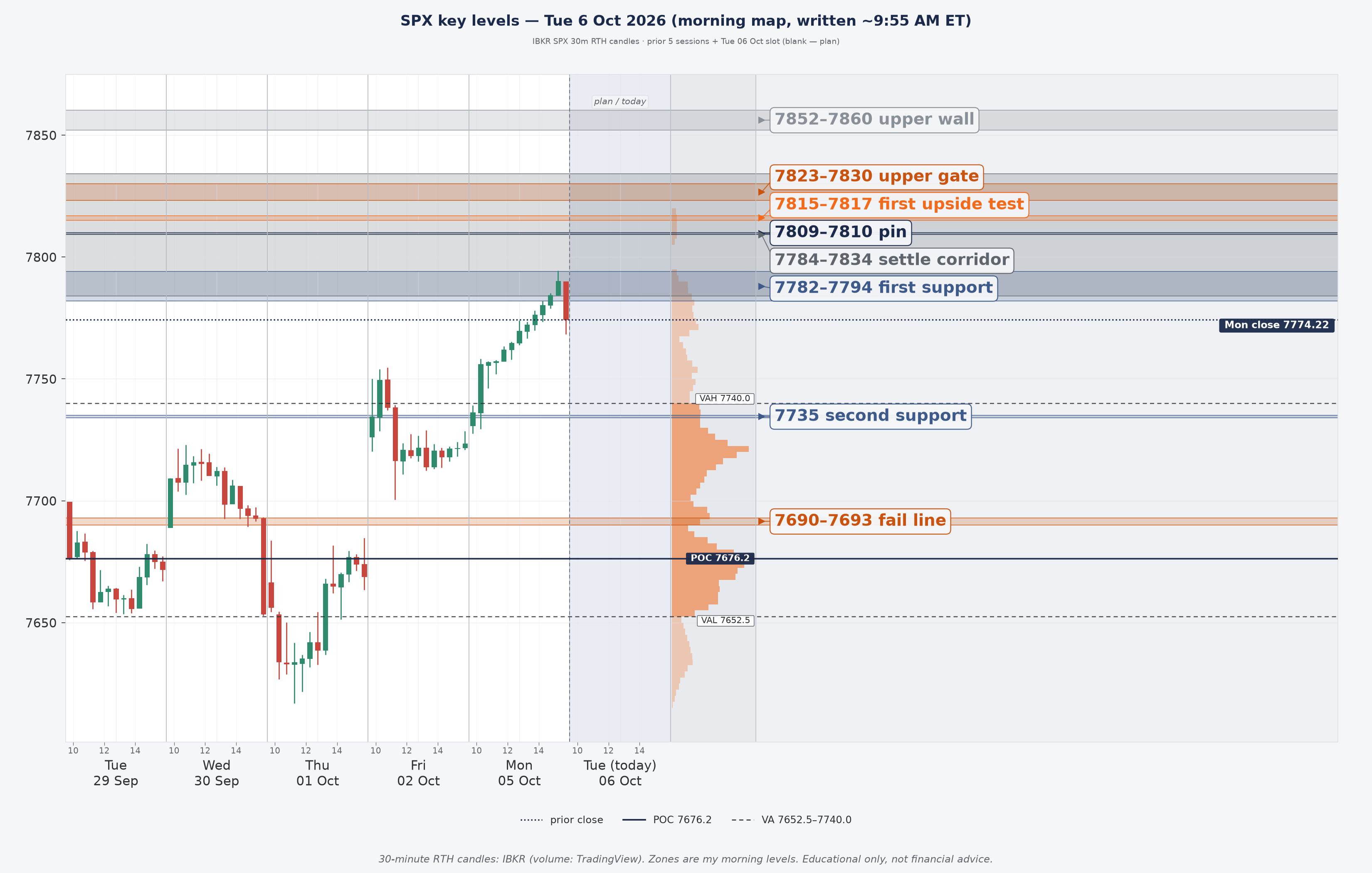
30-minute RTH candles (IBKR) for 29 Sep to 5 Oct, with a volume profile on the right. The shaded bands are today's levels. The empty slot is today. The dotted line is Monday's close of 7774.22.
The tape into the open
- Last five sessions: a slide from Tue 29 Sep (close 7670.84) to Wed 30 Sep's 7651.54 close, a Thursday wash to 7616.78 that bounced to 7666.45, Friday's gap up to a 7722.72 close, then Monday's open-test-drive higher: value migrated about 54 points up, Monday's high was 7794.35 and it settled 7774.22. That migration was accepted by time, not yet confirmed by volume.
- Overnight (SPX-equivalent): 7776.55–7815.05 (average about 7800.6). Futures were about 54 points rich to cash pre-open, so don't map futures levels onto this cash map.
- Vol and positioning: the 0DTE straddle priced about $24.50 (31 bps), an expected move of 7785–7834. Dealers are long gamma everywhere near spot, with the most gamma at 7855–7875, where customers sold a large block of calls. That damps moves rather than feeding them. VIX was 15.52 pre-open.
- What the open did: cash opened above Monday's high and value and pushed straight into the overnight high at 7815–7817. As of the delayed print around 9:50 ET, SPX was 7812.79. The first 30-minute bar is still open; I want a close decision at 7815–7817 before treating the upside branch as live.
The levels (strongest first)
1. 7809–7810: the pin
- Role: the day's center of gravity. Where I expect price to return when tests fail.
- Why it matters: 7810 is the moderate balance level, and a rejected test reverses back to balance. The opening forward was 7809.3, which is also where the weekly gamma flip sits (7809). The most-likely, median and mean prints cluster just under it at 7797–7803. Long gamma at and above spot means hedging leans against moves away from here.
- If / then: If 30-minute closes keep landing between 7800 and 7815, it's a pin day around 7810. A test of either edge that fails should rotate back here.
2. 7784–7834: the settle corridor
- Role: the base-case range for the day.
- Why it matters: the 0DTE expected move is 7785–7834, and the priced-in market corridor is 7784–7834, almost the same numbers. Inside it, long dealer gamma suppresses variance. The 50% band is 7782–7827.
- If / then: fade the edges, don't chase. If 30-minute closes stay inside 7784–7834, the pin keeps control. Leaving the corridor on a close is what opens the branches below and above.
3. 7815–7817: first upside test
- Role: the gate the open is already probing.
- Why it matters: 7815 is the first upside test; a cross sends balance to 7825 or extends to 7830. 7817 is the overnight high, and a rejection at the centroid back under 7817 returns price to the overnight range.
- If / then: I expect the first test to stall. If a 30-minute bar closes above 7817 and holds the retest, the next zone is the 7823–7830 gate. A reject here means back to the 7810 balance. That's still the base case.
4. 7782–7794: first support
- Role: the shelf under the corridor: Monday's upper value.
- Why it matters: a break of the 7800 test sends balance to 7785, a strong level. The same band holds Monday's value-area high (7791), Monday's high (7794) and the top of the plateau (7787). This is where the gap either holds as new value or starts to fill.
- If / then: If price is rejected back below 7794 and accepts inside Monday's value, expect rotation inside that value and a test of 7782–7785. Holding here on 30-minute closes keeps the gap as accepted value.
5. 7823–7830: upper gate
- Role: the decision line between a pin day and a push to the wall.
- Why it matters: 7825 is a moderate balance after a 7815 cross and 7830 the next upside test. The centroid of the priced-in distribution is 7823.32, and the body ends near 7827. Charm flow leans to the upside here, with buying pressure from 7830 toward 7860.
- If / then: If price is accepted above 7823 and crosses 7830 on a 30-minute close, the script points to the 7852–7860 wall. A failure back under 7815 puts it back in the pin.
6. 7852–7860: upper wall
- Role: the top of today's map, and where the short calls sit.
- Why it matters: 7860 is a strong balance and the largest customer short-call strike. 7852 is the upper break-even of the customer position, and 7859.55–7860.25 is the up pivot and target. Around 7850, spot up and vol up starts to make sense. If price drifts toward 7860, the usual pattern is that the short calls get bought back somewhere around 7825–7855 and rolled 10–20 points higher, late morning to early afternoon.
- If / then: this zone holds the rally unless it's accepted. Acceptance above 7852 (not before 10:00 ET, and for a full 30 minutes) would void the range: 7860 and then 7875 become targets, not fades.
7. 7735: second support
- Role: the deeper magnet if the gap fails.
- Why it matters: 7735 is the second downside test (a cross sends balance to 7715). The same number is the lower edge of the day's risk band (7735.03) and the mid-week straddle and gamma-peak area.
- If / then: this only comes into play after 7782–7794 fails. If a 30-minute close prints below 7785 and keeps going, expect a move toward 7735.
8. 7690–7693: fail line
- Role: where today's range thesis is wrong to the downside.
- Why it matters: 7690 is a moderate downside balance, and acceptance below 7693 voids the day's priced-in zone.
- If / then: a low-odds branch on a long-gamma day. Acceptance below 7693 would mean the dampening regime gave way, and I'd stop treating this as a range.
Day path
| Scenario | What it looks like | What would confirm it |
|---|---|---|
| Base: long-gamma pin | 7815–7817 rejects (or only spikes). Price rotates around 7809–7810 inside 7784–7834. | No 30m close above 7830 or below 7785. Rejections at the edges and responsive trade around the pin. |
| Upside extension | A 30m close above 7817, then acceptance above 7823–7830. Next stop 7852–7860, with the call-roll zone 7825–7855. | Holding above 7830 on the retest; speed into 7850. |
| Downside / gap fill | Rejected back below 7794 and accepted in Monday's value. Test of 7782–7785, then 7735 on a break. | A 30m close under 7785 with no bounce; acceptance in Monday's value. |
What would change my mind: a first hour that accepts above 7830 and holds the retest, which flips the base case from pin to a push toward the wall. Or a fast rejection back under 7794 that keeps going, which turns the gap into a fill.
How I'll grade this tonight: level by level against the 30-minute closes, then the day path, then how well the pin, the 7815–7817 test and the corridor framed the day's extremes.
Disclaimer: This post is for educational and informational purposes only. It is not financial advice and not a recommendation to buy or sell any security. The levels are my own map of where I expect the market to react, and I could be wrong. Do your own research.